





Industry Sector
Secure link for ophthalmologists & optometrists launched
Secure link for ophthalmologists & optometrists launched
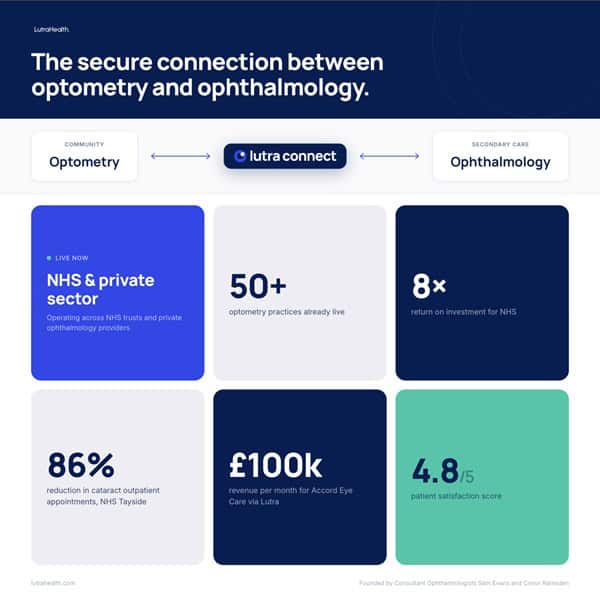
Lutra Connect has launched a secure platform connecting optometrists and ophthalmologists for clinical advice, guidance, referral and post-operative care.
Founded by Devon-based Consultant Ophthalmologists Sam Evans and Conor Ramsden alongside CEO Charles Solanki, the platform is the result of three years’ of development and structured feedback from more than 50 practices across the UK.
This addresses a problem that is widespread but rarely acknowledged: optometrists and ophthalmologists routinely sharing sensitive patient data via WhatsApp, personal email and, in some cases, fax.


“None of those channels are auditable or compliant with ICO guidance, and both sides carry liability when something goes wrong. Lutra Connect replaces them with a single, auditable and fully indemnified pathway covering:
- AI-assisted referrals
- clinical advice and guidance
- image sharing
- post-operative data collection fed to the National Ophthalmic Database
- patient-reported outcomes (PROMs and PREMs) fed to the Private Healthcare Information Network (PHIN),” said Conor Ramsden, Consultant Ophthalmologist and Co-founder, Lutra Health.
“I founded Lutra Health because I kept seeing optometrists who wanted advice and guidance from ophthalmology and had no proper way of getting it. They were left to make judgement calls alone or send patients into a referral pathway that did not need them, simply because there was no safe route to ask a question first. Greater access to advice and guidance between optometry and ophthalmology is what we are now providing,” he added.
The platform is already in use across private ophthalmology and NHS clinics. Accord Eye Care now has more than 30 community optometrists collaborating with its clinicians through Lutra Connect. In an NHS deployment with Tayside, 1,500 patients were processed through the system and 86% were listed directly for surgery via remote triage. Lutra Health’s focus is on optometry and private ophthalmology providers, where the demand for a structured, compliant alternative to informal channels is most acute.
A look at the currenjt market
UK private cataract surgery admissions increased by approximately 30% in six years: 80,875 in 2025; 77,655 in 2024 and 61,140 in 2019. It is the most common reason for admission to a private hospital (PHIN, June 2026).
Self-pay private cataract admissions reached 49,655 in 2025, up from 32,040 in 2019, while insured admissions were 31,220. The majority of people are paying privately for cataract surgery rather than through insurance.
Cataract care has shifted decisively toward independent providers. Around 60% of NHS-funded cataract surgery is now delivered by independent sector providers, up from under 20% in 2016, on top of the rising private self-pay volume. This fragments the pathway between the site of surgery and community follow-up.
Optometry and the post-operative cataract pathway
Community optometrists already deliver post-operative cataract assessments under local shared-care schemes across Scotland, Wales, London and elsewhere, but provision is a patchwork of local agreements rather than national infrastructure.
Case study: Where the model has been studied it works well: in a Cambridgeshire scheme, 60.6% of cataract patients were discharged to community optometrists on the day of surgery, with 93.8% of cases having an uneventful recovery and under 3% re-referred.
RCOphth has flagged the gap directly: with more patients followed up in the community, hospitals are now capturing post-operative outcome data in fewer than two-thirds of cases and the RCOpth has called for robust methods for optometrists to report surgical outcomes. This is the core case for better digital infrastructure connecting optometry and ophthalmology.