





General News
Callum Hunt awarded the 2026 Master’s Medal from the WCSM
Callum Hunt awarded the 2026 Master’s Medal from the WCSM
The Worshipful Company of Spectacle Makers (WCSM) this week announced the award of its 2026 Master’s Medal to Callum Hunt.
Callum studies at the University of Leicester, where he is enrolled on the Wellcome Trust PhD Programme in Genomic Epidemiology and Public Health Genomics.
He was awarded the Medal for Genome-Wide Insights Into the Genes and Pat
hways Shaping Human Foveal Development: Redefining the Genetic Landscape of Foveal Hypoplasia. This paper was published in September 2025 in Investigative Ophthalmology & Visual Science (IOVS).
The Medal-winning research is the first large genetic study of the shape of the human fovea (a central dip in the retina, which is responsible for sharp, detailed central vision). The team wanted to discover which genes shape the fovea, and how that links to foveal hypoplasia (a condition where the central dip is shallow or missing).
The research applied deep-learning algorithms to the OCT (optical coherence tomography) scans of over 60,000 UK Biobank participants, analysing the depth of the fovea and cross-referencing this against the participants’ genetic profiles. The results identified 129 genes likely to be involved in foveal development, and suggest that foveal shape varies along a spectrum: many common genetic differences shape the normal range, while single rare faults in key genes can push someone to the far end of the spectrum (i.e. towards foveal hypoplasia).
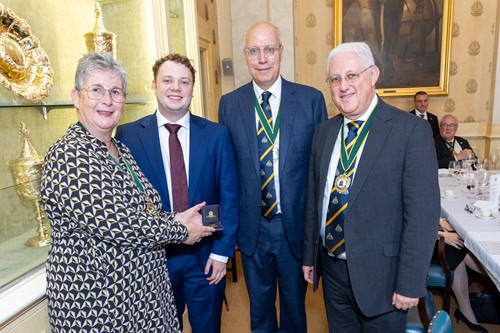
The Medal was presented to Callum Hunt by the outgoing Master, Fiona Anderson, and the incoming Master, David Baker, at a lunch on Wednesday 30 September.
The new Master Spectacle Maker, David Baker, who took office later that day, said: “Congratulations to Callum Hunt, a worthy winner of the 2026 Master’s Medal.
“This award is always highly competitive, and 2026 was no exception, but Callum’s research stood out. He and the team provide new insights into how the eye develops, give clinicians and researchers a clearer understanding of foveal hypoplasia, and lay a promising foundation for future work on diagnosis and treatment.
“It is particularly pleasing to recognise work of this quality so early in a research career. Encouraging the next generation of eye health researchers is central to the Company’s work, and we will follow Callum’s career with great interest.”