




General News
Eye care teams simulate cataract vision in football challenge

Eye care teams simulate cataract vision in football challenge
– revealing 75% drop in functional performance
SpaMedica and Freedom Vision highlight real-world impact of cataracts, beyond standard visual acuity testing
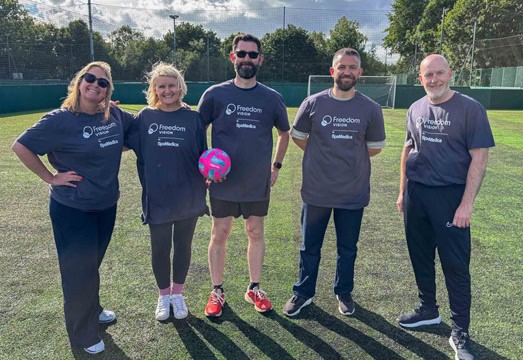
As the world turns its attention to football during Cataract Awareness Month (June), teams from SpaMedica and Freedom Vision have gone head-to-head in an initiative to demonstrate the functional impact of cataracts.
The Bolton-based event involved teams of hospital staff, head office employees and optical professionals from across the two ophthalmology brands, which offer cataract treatment to private patients (Freedom Vision) and NHS patients (SpaMedica).
Volunteer players participated in a series of penalty shootouts and crossbar challenges, wearing cataract simulation goggles to observe the real-world effects of the sight-stealing condition.
The results showed a significant decline in visual performance when donning the eyewear:
- Penalty accuracy across both teams dropped by 75%
- Successful crossbar attempts reduced by half
Professor Christine Purslow, Clinical Director of Outpatients at SpaMedica, described how the exercise reinforced the limitations of relying purely on visual acuity measures in clinical practice.
“We all work in the clinical environment, and every day we’re testing what people can see. But real life isn’t how many letters patients can see on a chart – it’s whether they can do the tasks they need to, and participate in things they enjoy.”
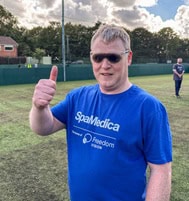
Participants reported notable difficulties with balance, spatial awareness and depth perception, which are key aspects of vision not always captured during routine eye tests.
Richard Peric-Matthews, NHS Trust Partnership Director who represented Team Freedom Vision said: “It was really difficult and my sense of balance went. It even made me feel a bit ill. It was a lot harder than I expected. I thought I’d still know where my feet were, but I definitely didn’t.”
Similarly, Scott Baxter, Head of Talent, described how the cataract simulation goggles affected his ability to carry out even basic tasks: “I felt quite dizzy, almost seasick after wearing them for a while. I understand how difficult it must be just to do simple things. Kicking a football is hard enough, but making a cup of tea must be a real challenge.”
Chief People Officer, Jo-anne Ratcliffe said: “What surprised me was how much it affected my ability to judge distance. I found myself having to consciously work out how far away the ball was and how to position myself before taking a shot.”
Jess Smith, B2B marketing lead for SpaMedica and Freedom Vision, helped organise the event. She added: “This challenge is about reinforcing what it’s like to live with cataracts and how people’s independence is taken away from them by this condition.
“Like much of the country, we’re all keenly anticipating the summer of football and cheering on the Three Lions, so this offered a great opportunity to get into the spirit and raise awareness of the impact of cataracts.”
Prof Purslow concluded: “This initiative indicates that incorporating functional questions into consultations, for example around driving, watching TV and mobility, could help optometrists identify vision issues assess where a referral may be appropriate.”
As part of the organisation’s football-themed activity, SpaMedica’s Chief Medical Officer Dr Alex Silvester is calling on optical healthcare professionals to help raise awareness of how this summer’s international games could help families spot the following five subtle warning signs of cataracts:
- Sitting closer to the TV than normal
- Confusing which players are on the ball due to deteriorating colour perception
- Asking family members for the score or time, because captions are appearing blurred
- Adjusting the TV brightness due to struggles with contrast and clarity
- Turning up the TV volume to compensate for vision impairment